
The global construction industry faces a critical challenge: the depletion of natural river sand and the environmental damage caused by its extraction. As a sustainable alternative, gneiss, a durable metamorphic rock, is emerging as an excellent raw material for manufacturing high-performance construction sand.
This comprehensive guide explores:
- What gneiss is and why it’s ideal for construction sand.
- Step-by-step processing methods—from quarrying to final product refinement.
- Essential equipment needed for efficient production.
- Environmental and Economic Benefits of Gneiss Sand over Traditional River Sand.
- Key challenges and solutions in manufacturing and market adoption.
By the end, you’ll understand how to transform gneiss into superior construction sand while supporting sustainable development.
-
What is Gneiss?
Geological Formation and Properties
Gneiss is a high-grade metamorphic rock formed under intense heat and pressure deep within the Earth’s crust. It originates from pre-existing igneous (e.g., granite) or sedimentary (e.g., shale) rocks that undergo recrystallization, resulting in a distinct banded texture.
Why Gneiss is Ideal for Construction Sand?
- Exceptional Hardness (6-7 Mohs Scale) – More durable than limestone or sandstone.
- Optimal Mineral Composition – Contains quartz, feldspar, and mica, enhancing strength.
- Low Weathering Susceptibility – Resists erosion, ensuring long-lasting performance.
- Abundant and Widely Available – Found in metamorphic regions worldwide.
- Unlike river sand, which varies in quality, gneiss-derived sand offers consistent gradation and superior mechanical properties, making it perfect for concrete, asphalt, and masonry work.
-
Gneiss Sand Processing Steps
1: Quarrying and Raw Material Extraction
- Gneiss blocks are extracted using controlled blasting, hydraulic breakers, or diamond wire saws.
- Large rocks (1-3 m³) are transported to the crushing plant via dump trucks or conveyors.
2: Crushing for Size Reduction
- Primary Crushing (Jaw Crusher) – Reduces raw gneiss to 6-8 inch fragments.
- Secondary Crushing (Cone/Impact Crusher) – Further breaks material into 1-2 inch pieces.
- Tertiary Crushing (VSI Crusher – Sand Maker) – Produces finely graded 0-5mm sand with cubical grains for better concrete bonding.
3: Screening and Grading
- Vibrating Screens separate sand into:
- Coarse sand (2-5mm) – For concrete and asphalt.
- Medium sand (0.5-2mm) – For plastering and masonry.
- Fine sand (0-0.5mm) – For specialized applications.
- Oversized particles are recirculated for further crushing.
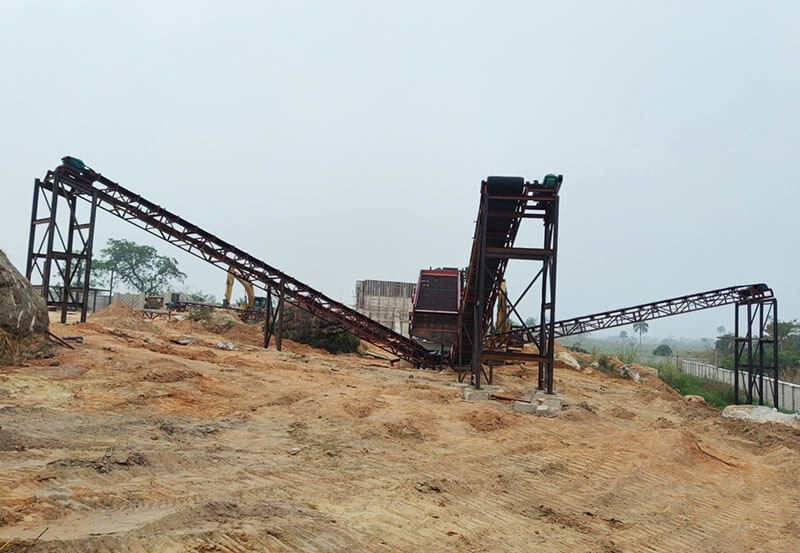
4: Washing and Removing Impurities
- Sand washers or Log Washers remove clay, silt, and organic matter.
- Hydrocyclones refine particle separation.
- Dewatering Screens reduce the moisture content.
5: Quality Control and Testing
- Grain Shape Analysis – Cubical grains improve concrete strength.
- Silt Content Test – Must be <3% (per ASTM C33 standards).
- Abrasion Resistance Test – Ensures durability (Los Angeles abrasion test).
6: Storage and Distribution
- Store processed sand in silos or bulk bags to prevent contamination.
- Ready for transport to construction sites or concrete plants.
-
Essential Equipment for Processing Gneiss Sand
To efficiently convert gneiss into high-quality construction sand, a well-designed processing plant requires specialized machinery.
- The primary equipment begins with jaw crushers, which handle the initial coarse crushing, reducing large gneiss blocks (1-3 m³) into manageable 6-8 inch fragments.
- For secondary crushing, cone crushers or impact crushers further break down the material into 1-2 inch pieces, ensuring optimal feed size for the final sand-making stage. The most critical equipment is the Vertical Shaft Impact (VSI) crusher, also known as a sand maker, which crushes the gneiss into finely graded 0-5mm particles with cubical shapes—essential for strong concrete bonding.
- After crushing, vibrating screens classify the sand into different grades (coarse, medium, and fine), while sand washers remove impurities like clay, silt, and dust to meet construction standards. Dewatering screens help reduce moisture content before storage, and dust control systems (such as baghouse filters or water sprayers) minimize airborne particles for environmental compliance.
- Investing in automated control systems can further optimize production efficiency, ensuring consistent quality while reducing operational costs. By selecting the right combination of crushers, screens, and washers, operators can maximize output and produce gneiss sand that meets or exceeds industry specifications.
-
Environmental and Economic Benefits of Gneiss Sand
Sustainability Advantages
- Eco-Friendly Alternative – Eliminates riverbed destruction.
- Lower Carbon Footprint – Can be powered by renewable energy sources.
- Waste Reduction – Quarry byproducts (fines) can be repurposed for road bases.
Economic Benefits
- Cost Savings – Reduces reliance on expensive river sand imports.
- Higher Demand – Many governments now mandate M-size sand in infrastructure projects.
- Long-Term Profitability – Stable supply chain compared to depleting river sand.
Challenges and Practical Solutions in Gneiss Sand Production
While processing gneiss into construction sand offers numerous benefits, producers often face several operational and market challenges.
- One of the primary hurdles is the high initial investment required for crushing and screening equipment, which can be mitigated by starting with modular, scalable plants that allow for gradual expansion as demand grows.
- Another significant challenge is controlling dust and fine particles during processing, which not only affects worker safety but also impacts environmental compliance. Implementing wet processing systems combined with advanced dust collection technologies can effectively address this issue.
- Additionally, ensuring the final product meets strict construction standards (such as ASTM C33 or IS 383) requires rigorous quality control measures, including regular testing for grain shape, silt content, and abrasion resistance. Perhaps the most persistent obstacle is market resistance to manufactured sand (M-Sand), as many contractors remain accustomed to traditional river sand.
- By proactively addressing these challenges with practical solutions, producers can optimize their operations, reduce costs, and successfully position gneiss sand as a viable alternative in the construction industry.
Conclusion
Processing gneiss into construction sand is a sustainable, profitable, and high-performance alternative to river sand. By following best practices in crushing, screening, and washing, manufacturers can produce sand that exceeds industry standards while reducing environmental harm. For mining companies and construction firms, gneiss sand represents the future of sustainable infrastructure development. With the right equipment and processes, you can lead this transformation while meeting global demand for eco-friendly building materials. Ready to start your gneiss sand production line? Consult with crushing experts to design an efficient and cost-effective plant tailored to your specific needs.
We offer customization for additional models to meet the diverse requirements of our customers. The price of the mining equipment will be determined by the manufacturer’s type, machine model, manufacturing process capacity, etc. We can provide a range of mining equipment, including stone crushers. You are welcome to consult JXSC‘s professional engineers to get a quotation based on your requirements. We can design a sand-making and crushing production line flow chart for you.
