
The global construction industry consumes nearly 50 billion tons of sand annually, leading to severe environmental degradation from riverbed and coastal sand mining. As natural sand reserves deplete, the mining sector is exploring sustainable alternatives—one of which is transforming zircon into construction-grade sand. Zircon (ZrSiO₄), traditionally used in ceramics, refractories, and nuclear applications, possesses properties that make it an excellent candidate for engineered construction sand. This blog provides an in-depth analysis of:
- What is zircon?
- The step-by-step process of converting zircon into construction sand
- Essential equipment required for efficient processing
- Benefits, challenges, and future potential of zircon sand in construction
By the end, mining professionals and construction material suppliers will understand how to leverage zircon sand as a high-performance, eco-friendly alternative to conventional sand.
Understanding Zircon: Composition, Sources, and Industrial Uses.
What is Zircon?
Zircon is a naturally occurring zirconium silicate mineral (ZrSiO₄) found in heavy mineral sand deposits. It is highly resistant to heat, corrosion, and mechanical wear, making it valuable across multiple industries.
Key Properties of Zircon:
- Zircon’s exceptional properties make it ideal for construction applications. With a hardness of 7.5 on the Mohs scale, it outperforms quartz in durability and abrasion resistance.
- Its extremely high melting point (2,550°C) suits high-temperature uses, while its density (4.6–4.7 g/cm³) enhances structural stability.
- Zircon is chemically inert, resisting acids, alkalis, and seawater corrosion. Though some deposits contain trace radioactivity (uranium/thorium), proper testing ensures safe usage. These qualities—hardness, thermal stability, density, and chemical resistance—position zircon as a superior alternative to conventional construction sand.
- Zircon is extracted as a byproduct of titanium mineral mining (ilmenite, rutile) from coastal or inland heavy mineral sand deposits.
Traditional Uses of Zircon
- Ceramics & Refractories – Zircon’s heat resistance makes it ideal for tiles and furnace linings.
- Zirconium Metal Production – Used in nuclear reactors and chemical plants.
- Foundry Sands – Binders for precision casting molds.
- Abrasive & Polishing Compounds – Due to their hardness.
Given its durability, repurposing zircon into construction sand presents a sustainable opportunity.
Why Use Zircon as Construction Sand?
- Depleting natural sand reserves due to over-mining (UN estimates sand is the 2nd most exploited resource after water).
- Environmental damage – Riverbed mining destroys ecosystems and increases flood risks.
- Regulatory bans – Many countries restrict river sand extraction.
Advantages of Zircon Sand
- Higher Strength – Improves concrete compressive strength by 10–15% compared to river sand.
- Uniform Grain Structure – Enhances workability in mortars and plasters.
- Thermal & Chemical Resistance – Ideal for specialized construction (e.g., nuclear facilities).
- Sustainable Alternative – Utilizes mining byproducts, reducing waste.
However, processing zircon into construction-grade sand requires specific techniques and equipment.
Transforming Zircon into Construction Sand Steps
-
Mining & Primary Separation
Extract Zircon Method:
Dredge Mining – Floating vessels scoop sand from underwater deposits.
Dry Mining – Bulldozers and scrapers collect inland sands.
Separation Techniques:
Spiral Concentrators – Separate heavy minerals (zircon, rutile) from lighter silica.
Wet Gravity Separation – Uses water flow to isolate denser zircon grains.
-
Crushing & Grinding
Raw zircon requires precise size reduction for construction use. The process begins with primary crushing in jaw crushers (50-100mm output), followed by secondary crushing via cone/impact crushers (10-20mm). Final grinding in ball mills or vertical roller mills achieves the optimal 0.1-4.75mm particle range.
Modern operations increasingly use high-pressure grinding rolls (HPGR) for energy efficiency and better particle shape control. Careful monitoring prevents over-grinding, which could compromise concrete workability. The resulting graded material then proceeds to washing and purification, ensuring optimal strength and uniformity for construction applications.
Note: Avoid over-grinding to prevent excessive fines.
-
Washing & Desliming
Removes clay, silt, and organic impurities that weaken concrete.
Sand Washers – Aggressive scrubbing action.
Attrition Scrubbers – Dislodge stuck particles.
Hydrocyclones – Separate ultra-fine particles (<75 microns).
-
Advanced Mineral Purification
Zircon often contains ilmenite, monazite, and radioactive thorium, requiring:
High-Intensity Magnetic Separation (HIMS) – Removes iron-bearing minerals.
Electrostatic Separation – Separates conductive (rutile) vs. non-conductive (zircon) grains.
Flotation (if needed) – For final impurity removal.
-
Sieving & Grading
Final product must meet ASTM C33 (concrete sand) or EN 13139 (mortar sand) standards:
The final stage in producing construction-grade zircon sand involves precise sieving and grading to meet industry standards. Multi-deck vibrating screens classify the sand into uniform particle sizes according to ASTM C33 or EN 13139 specifications. The optimal grading requires 95-100% passing through 4.75mm, with progressively smaller fractions down to 150 microns.
This controlled sizing enhances concrete strength, workability, and packing density. Air classifiers may refine finer particles, while quality checks using laser analyzers ensure consistent performance before distribution. Proper grading ensures zircon sand outperforms conventional alternatives in durability and application versatility.
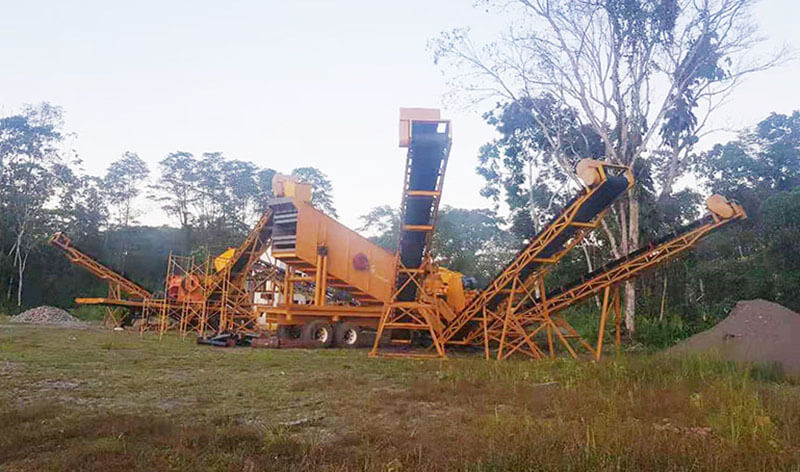
Vibrating Screens ensure precise grading.
-
Quality Control & Testing
Laser Particle Size Analysis – Verifies gradation.
X-Ray Fluorescence (XRF) – Checks for harmful impurities.
Radioactivity Testing – Ensures compliance with IAEA safety limits.
Essential Equipment for Zircon Sand Processing
-
Mining & Initial Processing
- Bucket-Wheel Dredgers – For offshore extraction.
- Spiral Concentrators – Primary heavy mineral separation.
-
Crushing & Grinding
- Jaw Crusher (Primary)
- HPGR (High-Pressure Grinding Rolls) – Energy-efficient alternative to ball mills.
-
Washing & Classification
- Attrition Scrubbers
- Hydrocyclone
-
Purification Systems
- Rare-Earth Roll Magnetic Separators (Up to 22,000 Gauss)
- Corona Electrostatic Separators
-
Screening & Storage
- Multi-Deck Vibrating Screens
- Silica Gel Desiccant Bins – Prevents moisture absorption.
Applications of Zircon Construction Sand
- High-Strength Concrete – Bridges, skyscrapers, marine structures.
- Refractory Mortars – For furnaces and kilns.
- Radiation-Shielding Concrete – Hospitals, nuclear plants.
- Decorative Finishes – Polished zircon sand for terrazzo flooring.
Challenges & Solutions
- While zircon sand offers superior properties for construction applications, its production faces several technical and commercial challenges. The primary concern involves potential trace radioactivity in some zircon deposits, requiring thorough testing and blending with inert materials to meet safety standards.
- Processing costs are typically higher than conventional sand due to energy-intensive grinding and purification steps. However, this can be mitigated through optimized high-pressure grinding roll (HPGR) technology and efficient mineral separation methods.
- Market adoption presents another hurdle, as many contractors remain unfamiliar with zircon sand’s benefits; targeted education on its enhanced durability and thermal resistance can drive wider acceptance. Additionally, the abrasive nature of zircon accelerates equipment wear, necessitating hardened liners and regular maintenance in processing plants.
- By implementing rigorous quality control, advanced processing technologies, and effective market education, these challenges can be overcome to position zircon sand as a viable, high-performance alternative in the construction materials sector.
Future Outlook
With recycled aggregates and manufactured sands gaining traction, zircon sand could capture 5–10% of the global construction sand market by 2030, especially in high-tech infrastructure projects.
Conclusion
Transforming zircon into construction sand is a technically feasible and environmentally responsible alternative to natural sand. By investing in advanced crushing, purification, and grading systems, mining companies can diversify revenue streams while supporting sustainable construction.
Key Takeaways:
- Zircon sand offers superior durability and thermal resistance.
- Processing requires specialized equipment for crushing, washing, and impurity removal.
- Quality control is critical to meet construction standards.
For mining operators, this represents a lucrative opportunity in the evolving construction materials sector.
We offer customization for additional models to meet the diverse requirements of our customers. The price of the mining equipment will be determined by the manufacturer’s type, machine model, manufacturing process capacity, etc. We can provide a range of mining equipment, including stone crushers. You are welcome to consult JXSC‘s professional engineers to get a quotation based on your requirements. We can design a sand-making and crushing production line flow chart for you.
