
In this guide, we’ll explore everything you need to know about processing Hemp-bone stone into premium artificial sand.
What Is Hemp-Bone Stone?
Hemp-bone stone is a type of sedimentary rock, specifically a sandstone. It is technically considered a variety of granite due to its similar mineral composition and hardness. The stone has speckled, pitted surface patterns (hence the “bone” and “hemp” references).
Key geological traits:
- Found in hilly terrains composed of continuous sedimentary sandstone.
- Formed from uniformly sized sand grains that are bonded together.
- High density, hard texture, weather-resistant, and wear-resistant.
These properties make Hemp-bone stone an excellent candidate for crushed stone and manufactured sand production.
Can Hemp-Bone Stone Be Used for Manufactured Sand?
Yes, absolutely.
Not only can Hemp-bone stone be processed into manufactured sand (M-sand), but it also produces a high-quality alternative to natural river sand. In fact, in many regions where river sand is becoming scarce or banned from extraction, Hemp-bone sand offers a reliable and environmentally responsible substitute.
Key advantages of Hemp-bone sand:
- High density and hardness – Suitable for structural concrete and heavy-load applications.
- Stable chemical properties – No harmful impurities, clay, or organic matter.
- Excellent particle shape – When processed correctly, the grains are cubical and angular, improving concrete strength.
- Consistent gradation – Can be controlled to produce coarse, medium, or fine sand (0.25–0.5 mm diameter).
- Wear resistance – Ideal for abrasive environments such as industrial floors and acid-proof linings.
Common applications include:
- Concrete production
- Bridge piers and dam construction
- Anti-corrosion floors
- Sulfuric acid tanks and chemical equipment linings
- Equipment anti-corrosion liners
In short, Hemp-bone stone is not only usable for M-sand — it’s a premium raw material.
What Is the Best Sand-Making Machine for Hemp-Bone Stone?
Given that Hemp-bone stone has a Mohs hardness of around 6.5 (similar to granite), not all crushers are suitable. Soft rock crushers, such as hammer mills or some impact crushers, would wear out too quickly or fail to produce the right grain shape.
After comparing various options, the most effective and economical choice is the Vertical Shaft Impact Crusher (VSI).
Why choose a VSI impact crusher for Hemp-bone stone?
- Handles hard and extremely hard materials – stones up to 6.5–7 Mohs.
- Produces excellent particle shape – Output is cubical, well-graded, and with low flakiness.
- High throughput – Capacity ranges from 60 to 650 tons per hour, depending on the model.
- Flexible feed sizes – Accepts feeding material up to 50mm.
- Low operational cost per ton – Due to the rock-on-rock crushing principle and wear-part design.
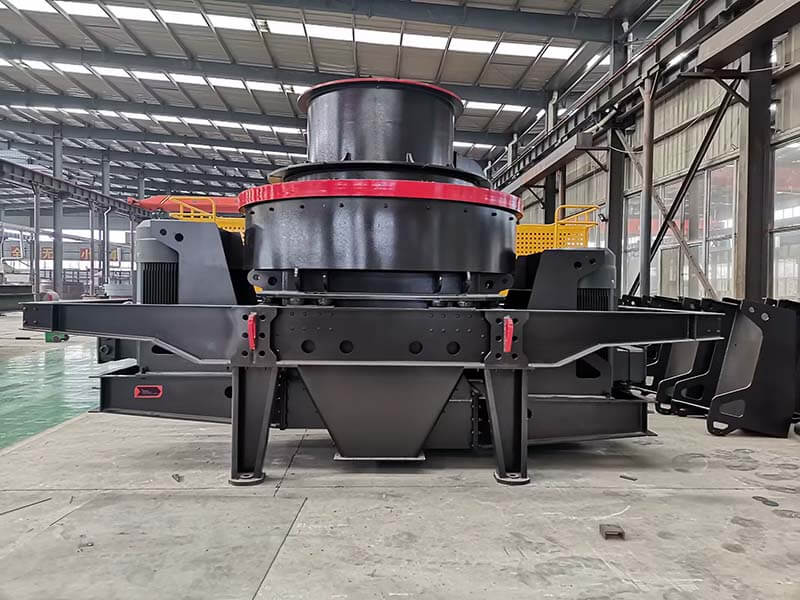
Key Features of a Modern VSI Sand Maker for Hemp-Bone Stone
When selecting a VSI crusher for Hemp-bone stone, look for these design features:
-
Flexible Feeding System
Allows switching between “cascade + center feed” and “full center feed” modes.
The adjustable material distributor plate prevents direct impact on the rotor wheel, reducing rotor wear.
-
Four-Port Rotor Design
Higher material throughput and more efficient acceleration.
Improves crushing ratio and finished sand output.
-
Reinforced Crushing Chamber
Balances wear liners and rock-on-rock crushing zones.
Lowers wear parts cost while increasing crushing efficiency.
-
Easy Maintenance Access Door
Quick replacement of rotor wear parts.
Minimizes downtime and maintenance labor.
-
Large-Volume Lower Casing with Wide Discharge
Prevents material clogging even at high moisture levels.
Ensures smooth, continuous operation.
Complete Sand Production Line – What Equipment Do You Need?
A single sand-making machine rarely works alone. To set up an efficient and profitable Hemp-bone stone sand plant, you’ll need a complete production line. Below is a typical equipment list arranged by process stage.
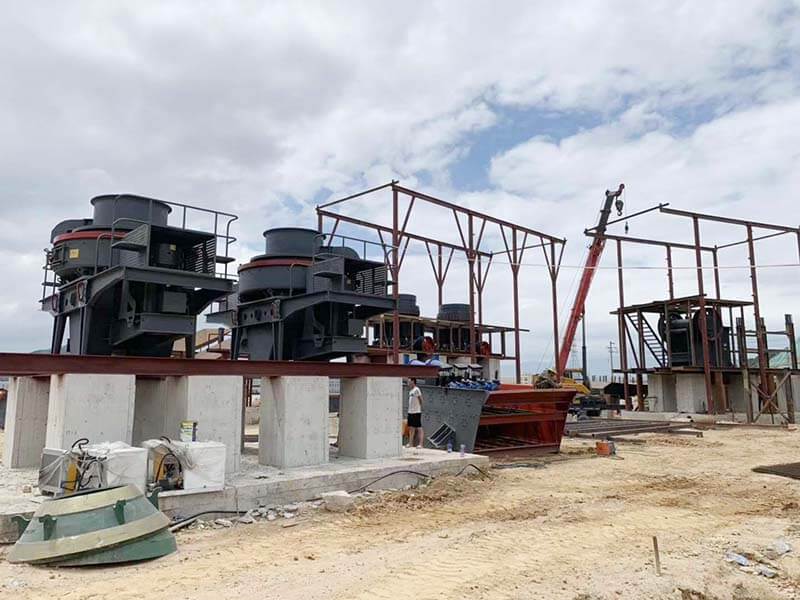
Stage 1: Primary Crushing
Equipment: Jaw crusher
Function: Reduces large Hemp-bone stone boulders (up to 500 mm or more) into medium-sized material (100–200 mm).
Stage 2: Secondary Crushing
Equipment: Cone crusher or impact crusher (depending on hardness preference)
Function: Further reduces material to under 50 mm, suitable for feeding the VSI sand maker.
Stage 3: Sand Making (Fine Crushing & Shaping)
Equipment: VSI impact crusher (as recommended above)
Function: Produces finished manufactured sand with optimal grain shape and gradation.
Stage 4: Screening & Washing (Optional but recommended)
Equipment: Vibrating screen + sand washer or fines recovery unit
Function:
Screens sand into different grades (0–0.25 mm, 0.25–0.5 mm, 0.5–1 mm, etc.).
Removes ultra-fines and dust for cleaner sand.
Recycles fine particles to maximize yield.
Stage 5: Conveying & Storage
Equipment: Belt conveyors + material bins or stockpile system
Function: Transfers material between crushers and screens, and stores final products.
Optional Equipment:
- Vibrating Feeder (vibrating grizzly feeder) – For even raw material supply.
- Dust collection system – To meet environmental regulations.
- Control system – Automated PLC control for optimal efficiency.
- Example Flow for a 150 t/h Hemp-Bone Stone Sand Plant
- Raw Hemp-bone stone (<600 mm) → Vibrating feeder → Jaw crusher (primary)
- Intermediate product (~150 mm) → Belt conveyor → Cone crusher (secondary)
- Crushed material (~40 mm) → Vibrating screen → Oversize returns to cone crusher, undersize feeds VSI sand maker
- VSI crusher output → Vibrating screen → Classified sand (0–0.5 mm, 0.5–1 mm, etc.)
- (Optional) Sand washer → Dewatering screen → Stockpile
Final Verdict: Is Hemp-Bone Stone Worth Processing?
Yes. Hemp-bone stone is an underutilized but excellent material for manufactured sand. It is hard, durable, and chemically stable — all the qualities needed for high-performance concrete and industrial applications. With the right VSI sand maker and a well-designed production line, you can produce sand that matches or even exceeds the quality of river sand.
If you are planning a Hemp-bone stone sand plant, prioritize a VSI impact crusher with a four-port rotor, flexible feeding, and easy maintenance access. Pair it with a jaw crusher, cone crusher, and vibrating screen for a complete, high-efficiency system.
Conclusion
Hemp-bone stone is far more than just a geological curiosity—it’s a durable, high-performance feedstock for manufactured sand that can readily replace natural river sand in demanding applications like concrete, bridge piers, and acid-proof flooring. While its hardness (Mohs 6.5) requires robust equipment, the right machinery makes all the difference. A VSI impact crusher stands out as the optimal choice, offering superior particle shaping, high throughput, and low wear costs. Paired with a complete production line—jaw crusher, cone crusher, and vibrating screen—Hemp-bone stone can be transformed into consistent, high-quality sand that meets modern construction standards. If you’re looking for a reliable, eco-friendly alternative to dwindling river sand supplies, it is well worth the investment.
We offer customization for additional models to meet the diverse requirements of our customers. The price of the mining equipment will be determined by the manufacturer’s type, machine model, manufacturing process capacity, etc. You are welcome to consult JXSC‘s professional engineers to get a quotation based on your requirements. We can design a sand-making and crushing production line flow chart for you.
