
When it comes to secondary and tertiary crushing in mining and aggregate production, cone crushers are the backbone of the operation. Among the various types available, the Short Head Cone Crusher stands out as a specialized machine designed for fine crushing. It is renowned for its durability, high wear resistance, and ability to handle hard stones such as granite, river pebbles, and cobblestone.
If you are exploring options for your crushing plant, you have likely encountered the terms “Short Head” and “Long Head” (often referred to as Standard) cone crushers. While they look similar, their applications and output characteristics are quite distinct. Below is a detailed guide on Short Head cone crusher models, specifications, and the critical differences between Short Head and Long Head cone crushers.
What is a Short Head Cone Crusher?
Short head cone crushers are tertiary crushers in the crushing circuit. Their primary function is to produce finely graded materials. The defining feature of this machine is its long parallel zone. This extended parallel section ensures that materials are compressed multiple times as they pass through the chamber, resulting in a more uniform and finer product size.

Key Characteristics:
- High Wear Resistance: Built to crush high-hardness stones such as granite, basalt, and iron ore.
- Uniform Output: The long parallel zone guarantees that the final product has a consistent grain shape with minimal needle-like or flaky particles.
- High Efficiency: Optimized design with high speed and short stroke increases crushing efficiency.
Short Head Cone Crusher: Models & Specifications
When selecting a short head cone crusher, understanding the model parameters is crucial. These models are classified based on the crushing chamber profile and the length of the parallel zone.
Unlike standard types, short head models have a longer parallel zone. Generally, cone crushers have three chamber types based on application:
- Standard Type: Used for medium crushing.
- Medium Type: Used for a combination of medium and fine crushing.
- Short Head Type: Used specifically for fine crushing.
Common Model Specifications:
Short head cone crushers are available in several specifications to meet varying production demands. Here are the general parameters:
- Feed Opening Size: 65mm – 230mm
- Discharge Setting: 3mm – 60mm
- Production Capacity: 40 – 700 tons per hour
Note: The longer the parallel zone (as seen in short head types), the more uniform the crushed product will be.
6 Key Features of Short Head Cone Crushers
Advanced Structural Design
The optimized design combines high rotating speed with a short stroke, resulting in a significant increase in production capacity and crushing efficiency compared to older models.
Durability and Stability
Critical crushing components adopt high-manganese steel wear parts. This robust construction reduces wear and tear, ensuring stable operation under heavy loads.
Superior Product Shape
The unique crushing principle—inter-particle crushing—ensures that the final product is cubical in shape. It effectively reduces the generation of flaky or needle-shaped stones, making it ideal for high-grade concrete and asphalt.
Interchangeable Crushing Cavities
Operators can easily change the crushing cavity by replacing the fixed cone (mantle and concave). This allows the same crusher to be adapted for different feed sizes and output requirements.
Hydraulic & Lubrication Systems
Dual-protection systems are standard. The hydraulic system provides overload protection to prevent damage from uncrushable materials, while the advanced lubrication system ensures consistent bearing performance and extends maintenance intervals.
Easy Maintenance
All components are easy to use. Parts can be disassembled and maintained from the top or side, reducing downtime significantly compared to traditional crushers.
Short Head vs. Long Head (Standard) Cone Crusher: The Key Differences
One of the most common questions in the aggregate industry is: What is the difference between a long head and a short head cone crusher?
In industry terminology, the “Long Head” typically refers to the Standard cone crusher, while the “Short Head” is the fine-crushing variant. Their differences go beyond just the physical shape; they impact the entire crushing circuit.
-
Product Granularity
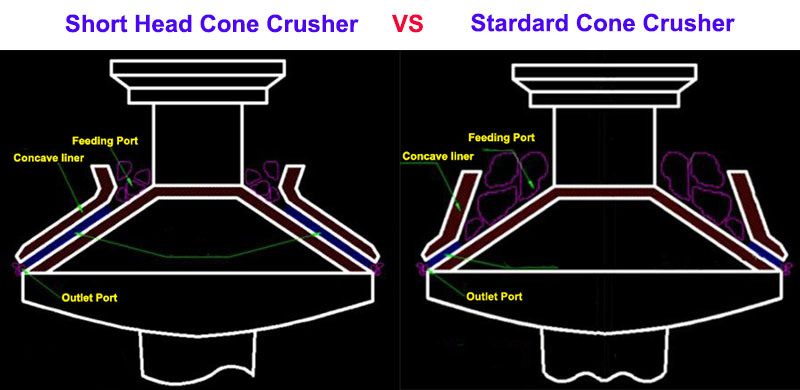
- Short Head: Features a long parallel zone. This allows the material to be compressed repeatedly, producing a finer and more uniform output. It is ideally used as a tertiary crusher for shaping and final sizing.
- Long Head (Standard): Has a shorter parallel zone. The material passes through relatively quickly, resulting in a coarser output. It is a secondary crusher after a jaw crusher.
-
Crushing Cavity Shape
- Short Head: The crushing chamber is deeper with a longer parallel strip at the bottom. This slows down the material, allowing for more compression cycles.
- Long Head (Standard): The chamber is more open with a shorter parallel strip. It is designed to accept larger feed sizes without bridging.
-
Discharge Opening (Closed Side Setting – CSS)
- Short Head: Generally has a narrower discharge setting to close the gap to achieve fine material reduction.
- Long Head (Standard): Utilizes a wider discharge opening. This allows for higher throughput capacity (tons per hour) because the material doesn’t need to be reduced to a very fine size at this stage.
-
Feed Size Capacity
- Short Head: Designed for smaller feed sizes. It typically requires material that has already been crushed (usually by a Standard cone crusher or jaw crusher).
- Long Head (Standard): Designed for larger feed sizes. It can accept the direct output from a primary jaw crusher.
Summary Comparison Table
| Feature | Short Head Cone Crusher | Long Head (Standard) Cone Crusher |
| Application | Tertiary / Fine Crushing | Secondary / Medium Crushing |
| Parallel Zone | Long | Short |
| Product Size | Fine & Uniform | Coarse |
| Throughput | Lower (due to smaller cavity) | Higher (due to larger cavity) |
| Feed Opening | Small (65mm – 230mm) | Large (up to 400mm+) |
| Crushing Cavity | Deep with long parallel strip | Shallow with short parallel strip |
Practical Application Example
To illustrate how these differences apply in real-world scenarios, consider a hard rock quarry processing granite:
Stage 1: A Jaw Crusher breaks the raw granite down to a manageable size (approx. 200mm–300mm).
Stage 2: A Long Head (Standard) Cone Crusher takes over. It handles the larger feed, crushing the granite down to 40–60mm. The focus here is on high throughput.
Stage 3: Feed the output from the standard cone into a Short Head Cone Crusher. The short head’s long parallel zone and tight discharge setting refine the material to 5mm–20mm aggregates. At this stage, the focus is on producing a cubical, high-quality final product suitable for asphalt or concrete.
Conclusion
Selecting between a Short Head and Long Head (Standard) cone crusher depends entirely on your stage in the crushing circuit.
- Choose a Short Head Cone Crusher when your goal is fine crushing. Its long parallel zone delivers uniform, cubical aggregates, making it ideal for tertiary stages. With capacities ranging from 40 to 700 tons per hour, it excels at producing high-grade final products.
- Conversely, opt for a Long Head (Standard) Cone Crusher for secondary crushing, where high throughput and larger feed sizes are the priorities.
- Understanding these distinctions—particularly parallel zone length and output granularity—ensures you optimize your plant for maximum efficiency and profitability.
We offer customization for additional models to meet the diverse requirements of our customers. The price of the mining equipment will be determined by the manufacturer’s type, machine model, manufacturing process capacity, etc. You are welcome to consult JXSC‘s professional engineers to get a quotation based on your requirements. We can design a sand-making and crushing production line flow chart for you.
